A music press kit is eight things on one page: header, bio, music, video, press, dates, photos, contact. What follows is each section with a length target, a brief, and an example from a sample band (Sierra Veil, who are made up) so you can see the finished version, not just the placeholder. Copy the structure or use the editor that has it built in.
01 A note on terminology
Press kit, EPK, one-sheet: same idea.
"Music press kit" is the older name. EPK (electronic press kit) is the modern, web-based version, with the same sections collected into one shareable link. A "one-sheet" is the trimmed-down single-page version that A&R desks sometimes ask for. In the UK and Australia the same thing usually goes by "press pack" or "promo pack." Same materials, different containers.
This template covers everything you'd put in a press kit. Build it as an EPK if you want venues and booking agents to actually open it. If you want the full backstory on the format, see what is an EPK.
02 The template
The eight sections of a music press kit, in order.
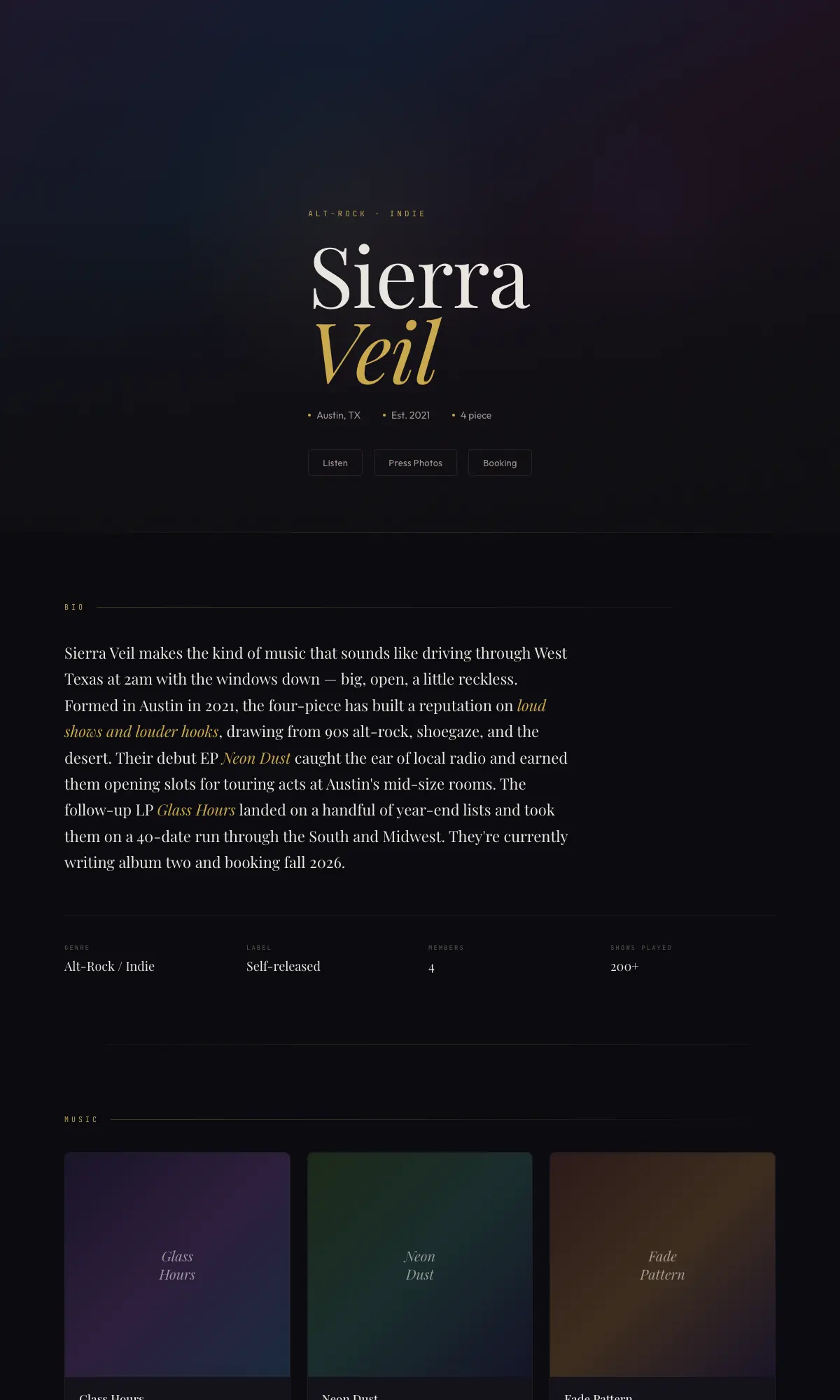
Examples are drawn from Sierra Veil, a fictional alt-rock four-piece from Austin, TX. You can open the finished press kit to see how the sections come together once they're laid out.
01The header8–15 words
Name, a one-line tagline that places your sound and your city, and one hero photo wide enough to crop. This is the first impression and the only thing that loads before they decide to keep scrolling.
Mistake to avoid. Burying the genre and city under three paragraphs of bio. They should be visible in the first two seconds.
02The bio80–150 words
Three short paragraphs: what you sound like, what you've done, what's happening right now. Open with the sound. Don't open with the year you were born.
Example — Sierra Veil
Sierra Veil makes the kind of music that sounds like driving through West Texas at 2am with the windows down: big, open, a little reckless. Formed in Austin in 2021, the four-piece has built a reputation on loud shows and louder hooks, drawing from 90s alt-rock, shoegaze, and the desert.
Their debut EP Neon Dust caught the ear of local radio and earned them opening slots for touring acts at Austin's mid-size rooms. The follow-up LP Glass Hours landed on a handful of year-end lists and took them on a 40-date run through the South and Midwest.
They're currently writing album two and booking fall 2026.
Mistake to avoid. "Born in 1994 in…" Nobody is reading a chronological bio. Lead with the sound and the now; earn the right to the backstory.
03The music2–3 tracks, embedded
Two or three of your strongest tracks, embedded so they play inline. Lead with your single best song, not your latest. A booking agent listens to the first ten seconds of the first track; if it doesn't land, the page closes.
Example — Sierra Veil
Glass Hours — LP · 2025 · Spotify / Apple / Bandcamp Lead track: "Satellite Weather" (3:42)
Neon Dust — EP · 2023 · Spotify / Apple / Bandcamp
Fade Pattern — Single · 2024 · Spotify / Apple
Mistake to avoid. Posting eight tracks. An EPK is the highlight reel, not the discography. Three is plenty.
04The video1 clip, under 5 min
One clip. A live performance is usually stronger than a polished music video for booking, because it answers the question booking agents are actually asking: can you do this in a room for forty-five minutes?
Example — Sierra Veil
"Satellite Weather" — Official VideoDirected by Marcus Cole · 2025 · YouTube
Mistake to avoid. Three videos. One that does the work beats three that don't.
05Press quotes2 short pulls
Two short quotes from real outlets, with the source line under each. Borrowed credibility. Lead with the strongest. Pick lines that say something specific, not generic praise.
Example — Sierra Veil
"Sierra Veil makes guitars sound urgent again. Glass Hours is the best Austin rock record this year."— Capital City Weekly
"One of the tightest live bands in Texas right now. If they're playing your town, don't miss it."— Hill Country Radio
Mistake to avoid. Five quotes. The third one diminishes the first. Two strong is better than five weak.
06Live dates3–5 dates
Three to five upcoming shows or three recent ones if you're between tours. Date, venue, city. Optional but it signals momentum. If you don't have any yet, skip it entirely.
Example — Sierra Veil
Sep 12The Pecan Street SocialAustin, TX
Sep 18The Lamp WorksColumbia, MO
Sep 20Eastside AnnexNashville, TN
Oct 03Little Five HallAtlanta, GA
Oct 11The Tobacco BarnCarrboro, NC
Mistake to avoid. Leaving last year's dates up. Stale tour dates are worse than no tour dates.
07Photos & downloads2–4 hi-res
Two to four hi-res shots a venue or magazine can actually use, with a one-click download for each (and ideally a ZIP for all of them). At least one wide enough to crop horizontally for a venue banner. Put your stage plot and tech rider here too, so the engineer gets them with the photos.
Example — Sierra Veil
Live at The Pecan Street Social · 2025 · ↓ hi-res download
Promo · Studio · 2025 · ↓ hi-res download
Band Portrait · 2024 · ↓ hi-res download
↓ Download all photos (ZIP)
Mistake to avoid. Photos behind a Google Drive permission wall. The venue gives up; you lose the gig.
08ContactReal email, not a form
A working email for booking. If you have separate management and press contacts, list those too. Socials at the bottom. Forms are for ticketing companies; people reply to people.
Once you have the sections, a few rules of thumb make the difference between a press kit that gets read and one that gets closed:
One page, one link. A press kit is meant to be skimmed in two minutes. If a booking agent has to click through five tabs, you've lost them.
Order by importance, not by chronology. Header, bio, music, video. Then press, dates, photos, contact. Lead with what makes the case.
Mobile-first. Most pitches get opened on a phone in the back of a venue. If it doesn't read well at 375px wide, fix that before anything else.
Embed, don't link. Music that plays inline gets heard. A "click to listen" link gets skipped.
Update the link, not the version. A press kit is a living page, not a v3-final-FINAL.pdf. Edit it once, the link stays the same, every booking agent who's ever opened it sees the current version.
A press kit that updates itself is the difference between a tool and a chore.
04 By genre: hip hop
The hip hop press kit template.
A hip hop press kit uses the same eight sections. What changes is what a promoter needs to see in them. A rock band gets asked “how many of you are there?” A rapper gets asked “what does the show actually look like?” Answer that, and you are ahead of most kits in the inbox.
Header: name, city, and your lane. Boom bap, trap, drill, alternative, conscious. Promoters build bills by lane, so say it in the first line.
Bio: say whether you make your own beats. Rapper, producer, or both changes who books you and for what. List features and producers only if they are real and current.
Music: lead with the project. One album, mixtape or EP with its cover, a full tracklist with features marked, and one player that works on a phone. Stream counts help only when they are recent and you date them.
Video: one official video and one live clip. The live clip matters more. A promoter wants to see you carry a verse without a vocal track underneath.
Quick facts: the show. With a DJ or with a band, how long the set runs, how many people are on stage, and whether you have a clean set for festivals, colleges and city events.
Tech rider: keep it short. A stable table for the DJ, two lines to the house system, your vocal mic and a spare, one wedge, vocal up front. Make it free with the tech rider template.
HHA hip hop short bioAbout 60 words
Who you are, where you are from, whether you produce, the current project, and what the live show is. Third person, so a promoter can paste it.
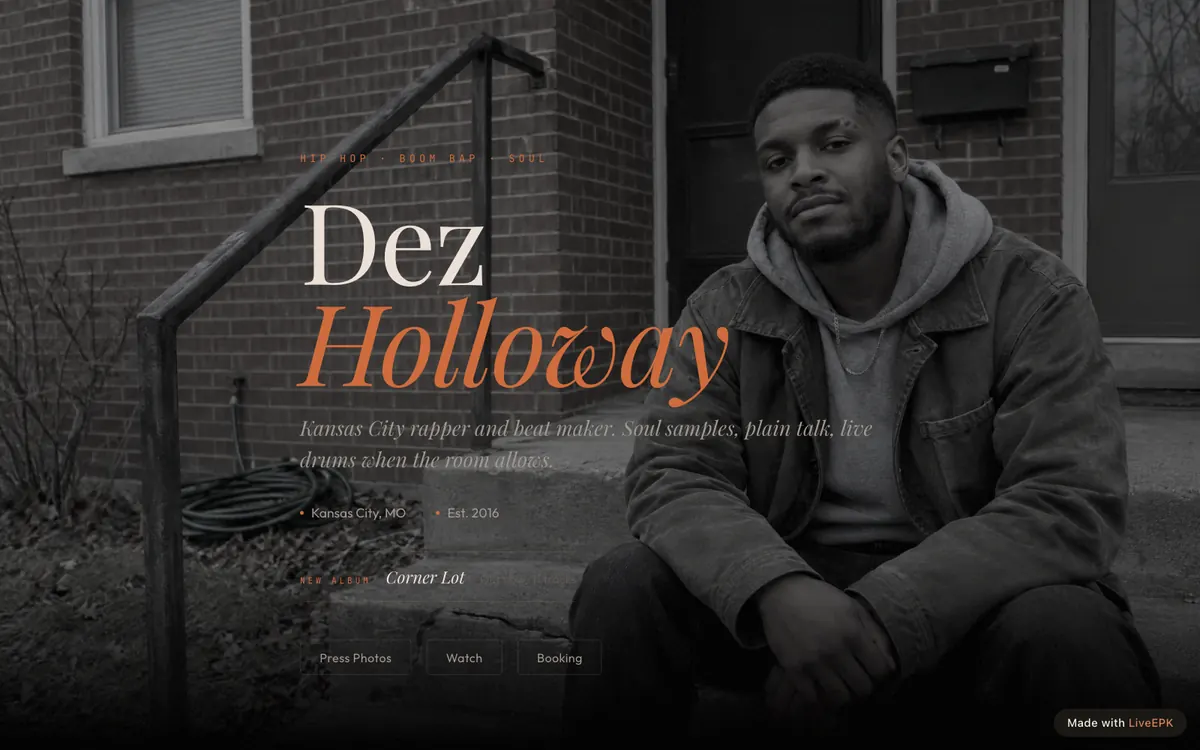
Example: Dez Holloway (a sample artist)
Dez Holloway is a rapper and beat maker from Kansas City, Missouri. He produces his own records from a spare-bedroom studio and performs with a DJ or a three-piece band. His second album, Corner Lot, came out in March 2026. He has played 40-plus shows across the Midwest since 2023.
Mistake to avoid. A bio that is all adjectives and no facts. “Versatile lyricist with a unique sound” tells a promoter nothing. A city, a project and a show count do. Ten more bios in the same shape, one per genre, are on the musician bio examples page.
A hip hop press kit example
This is a finished hip hop kit built with LiveEPK. Dez Holloway is a sample artist we made up to show how it looks when it is done right, and he is labeled that way. Open it and scroll: both ways to book him are in the bio, the quick facts and the rider, the album has a full tracklist, and the photos show a crowd and a home studio.
More finished kits by genre, with notes on why each works: EPK examples. Playing out as a DJ too? See the DJ press kit guide.
05 Where LiveEPK fits
The shortcut, if you want one.
LiveEPK is an EPK builder for working musicians, with every one of these eight sections already built in. You drop in your bio, paste your Spotify and YouTube links (they auto-embed), upload two or three photos, and you have a press kit at a real URL in about twenty minutes. Pick from three templates and you don't have to think about layout at all.
Publishing is free too: your kit goes live at a generated link with a small LiveEPK badge. $5/month puts it at your own subdomain (yourname.liveepk.com, no badge) and adds an email composer that drafts booking pitches with your assets pulled into the message, and a shared asset library so you're not re-uploading the same photo. See full pricing.
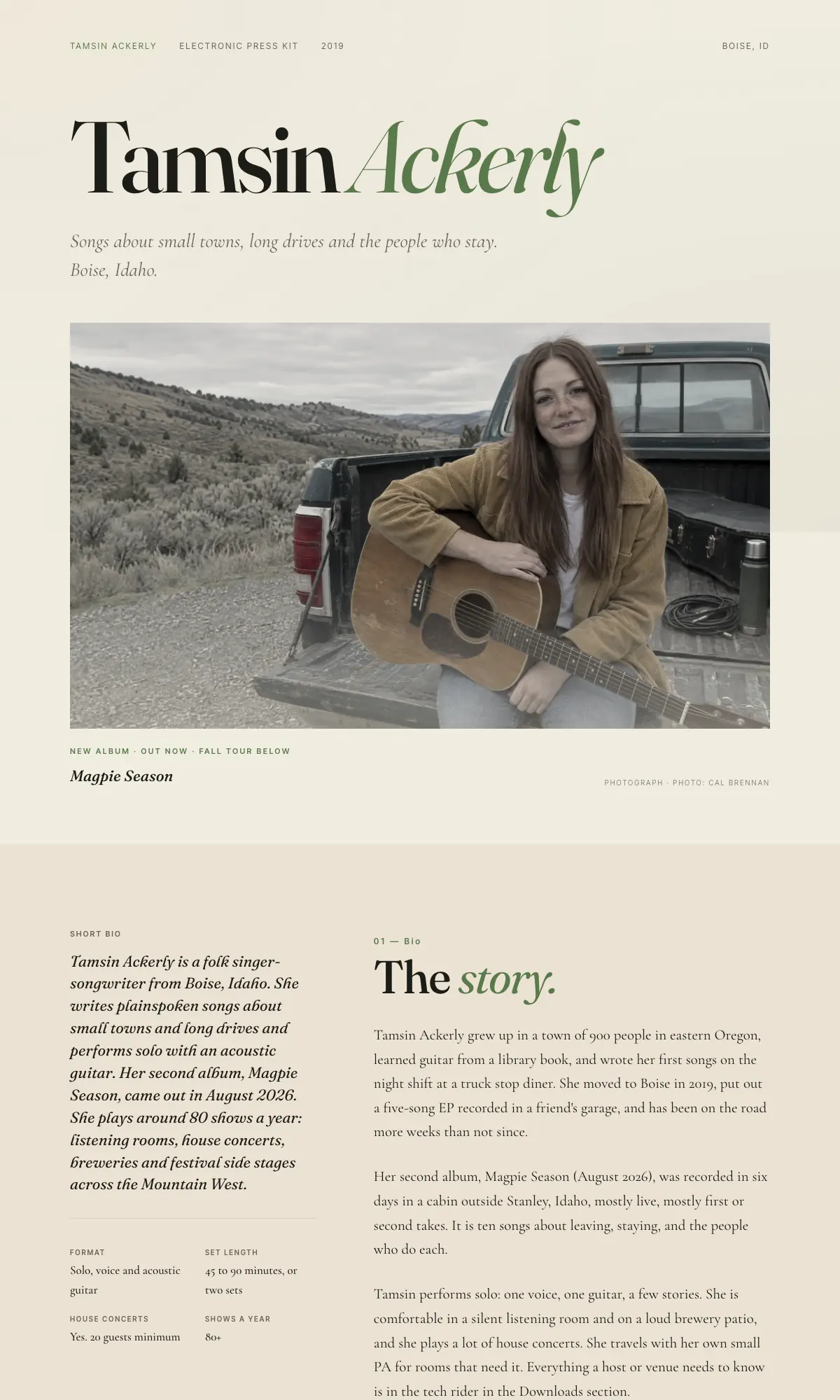
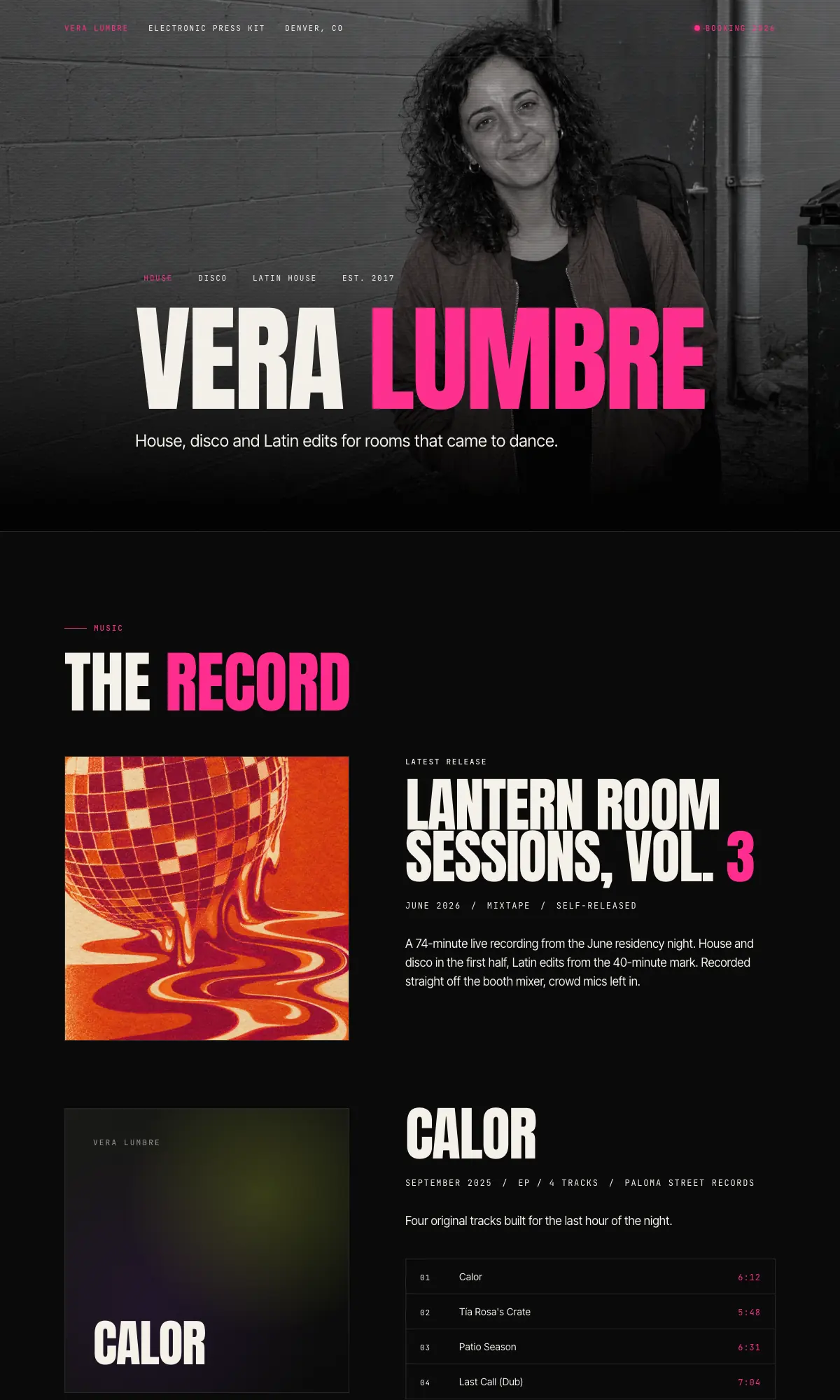
Want to see finished ones? Open six EPK examples by music genre: a rock band, a DJ, a hip hop artist, a jazz trio, a wedding band and a singer-songwriter, with notes on why each one works.
06 Quick answers
Music press kit template: common questions.
What is a music press kit?
A music press kit is a single page that holds a musician's bio, music, video, photos, press quotes, live dates, and contact info, so venues, booking agents, labels, and journalists can find everything in one place. The modern web version of a press kit is called an EPK (electronic press kit) and lives at a single shareable link.
What should be in a music press kit?
Eight sections in this order: header (name, tagline, hero photo), bio (three paragraphs), music (two or three embedded tracks), video (one live clip), press quotes (two short pulls), live dates (three upcoming or recent), photos and downloads (hi-res), and contact (a real email, not a form). That covers every question a booking agent or journalist would think to ask.
What should a hip hop press kit include?
The same eight sections as any music press kit, tuned for a promoter booking a rapper: your lane and city in the header, whether you make your own beats, one project with a full tracklist, an official video plus a live clip, the show format (with a DJ or a band, set length, how many on stage, whether you have a clean set), and a short tech rider. There is a hip hop template and example above.
Is a press pack the same as a press kit?
Yes. "Press pack" and "promo pack" are the usual British and Australian names for the same thing: bio, music, photos, press, dates, contact. A band press pack template is this template. Build it as a web link rather than a PDF and it works for bookers on either side of the Atlantic.
Is a music press kit the same as an EPK?
Yes. EPK stands for electronic press kit and is the modern, web-based version. Same materials, same purpose. The EPK lives at a link instead of in a PDF or folder, which is what venues and booking agents actually want to open.
Do I need to download anything to use this template?
No. The page is the template. Each of the eight sections is shown with a brief, a length target, and a filled-in example from a sample band so you can see what the finished version looks like. You can copy the structure into any doc, or skip the doc and use the LiveEPK editor, which has every section pre-built.
How long should a music press kit be?
One scrollable page. A press kit is meant to be skimmed in two minutes on a phone, not read like a brochure. Lead with the strongest material and keep each section tight.
Can I make a music press kit for free?
Yes, start to finish. The LiveEPK editor is free with no credit card, and it publishes your press kit live at a generated link with a small badge. $5/month (or $50/year) moves it to your own subdomain without the badge. The free EPK builder page lays out exactly what free includes.
Build yours.
The eight sections, pre-built in the free editor. Open it and start filling in.