The short version
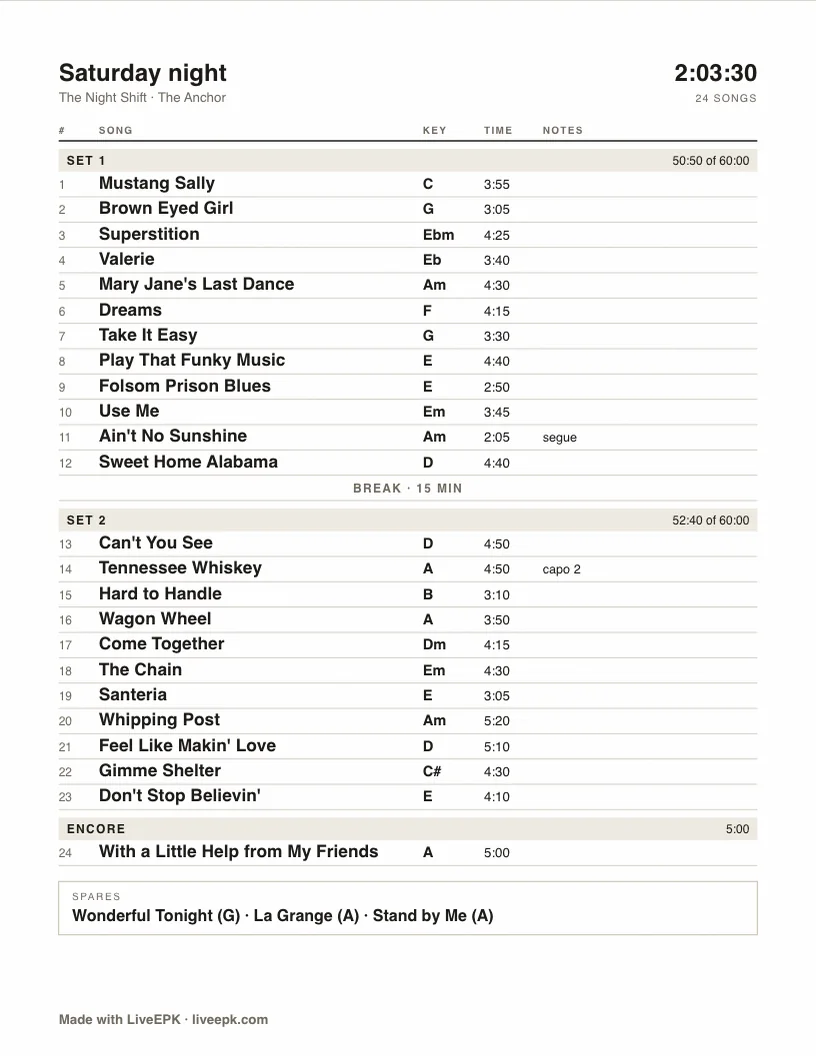
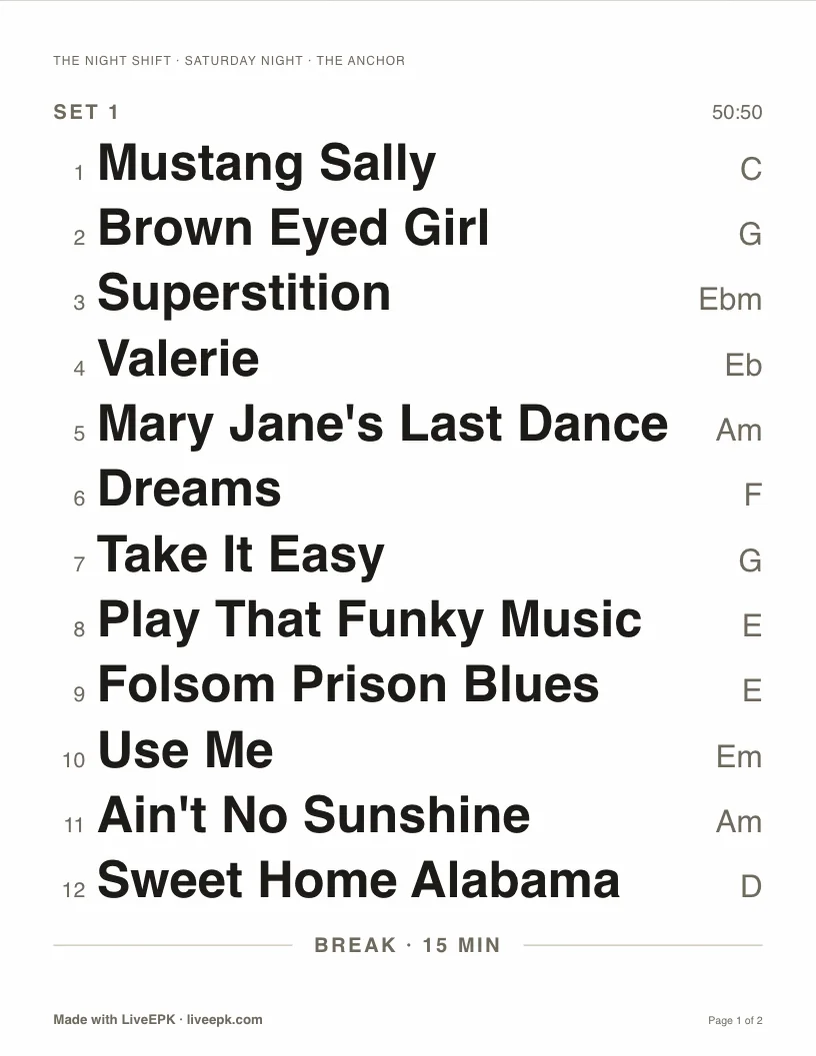
A setlist is the songs you will play, in order, on one page. The copy on the stage floor needs titles only, in the biggest bold type that fits. The band's copy adds keys and notes, and the sound engineer's adds the running time. Build it once and print all three.
01 The tool above
A free setlist maker, no account at any step.
You will see this kind of tool called a setlist maker, a set list maker, a setlist creator, a setlist generator, or a setlist builder. Same job under every name: put your songs in order and get a page you can read on a dark stage. The examples on the setlist template page open here ready to edit.
- No account, ever. Not to start, not to download, not to share. Nothing is uploaded; your setlist is saved in your own browser.
- Paste the list you already have. Numbers, bullets, "Title - Artist", a key in brackets, a length like 3:45, and Set, Break and Encore lines are all read.
- The stage sheet sizes its own type. It uses the largest bold type that fits the page, up to 54 point. When the whole show will not fit at 24 point, each set gets its own page.
- Three copies from one list: Stage (titles, with keys in the margin if you want them), Band (key, tempo, length, notes) and Sound (lengths and a running clock).
- A running time for each set, with the gap between songs counted, against the set length you were given.
- Sets, breaks, an encore, and a spares box for the songs you might call.
- A share link that opens on any phone, in a dark stage view with large type. Tap a song when it is done. No account for your bandmates either.
- Free PDF, Letter or A4, with no watermark. Each sheet carries one small credit line at the foot.
02 How to make a setlist
How to make a setlist: order first, then time it.
- List everything you could play. Paste it in. Do not order it yet.
- Pick the opener and the closer. Open with a song the band plays well without thinking. Close with the one people came for.
- Fill the middle in waves. Two or three songs up, one down. Put the slow one where the room needs a breath, not where it empties the floor.
- Group songs that share a setup. Same tuning, same capo, same instrument. Every change is dead air.
- Add the lengths and check the clock. A set that runs over gets cut by the venue, usually before your best song.
- Move the extras to spares. Two or three songs you can call if the night runs long or a request comes in.
03 What goes on it
What goes on a stage setlist: titles you can read from the floor.
The page taped to the stage answers one question: what is next. Everything else is for a different copy.
- Song titles, bold, as large as the page allows. You read it standing up, in bad light, with a guitar in the way. Thin type washes out under stage lights.
- The key, if anyone needs it. In the margin, smaller than the title.
- Set labels and breaks, so nobody starts set two early.
- A rule above the encore.
- Spares in a box at the foot.
Capo positions, who starts the song, tempo and tunings belong on the band copy, where there is room for a notes column. The sound engineer wants lengths, a running clock and anything that changes on stage: a lead vocal swap, an acoustic guitar, a track.
04 How many songs
How many songs in a set: 30, 45, 60 and 90 minutes.
Count on about four minutes a song once you add the talking, tuning and applause between them. Short punk songs and long jams move the number, which is why the tool adds up real lengths.
| Set length | Songs | Typical gig |
|---|---|---|
| 30 minutes | 7 to 8 | Opening slot, showcase, festival side stage |
| 45 minutes | 10 to 12 | Support slot, one set of a bar night |
| 60 minutes | 14 to 16 | Headline club set, one wedding set |
| 90 minutes | 20 to 24 | Headline show, solo restaurant or patio gig |
| 3 x 45 minutes | 30 to 36 | Cover band bar night |
05 By kind of act
A setlist for a cover band, a wedding band, an original band and a solo act: same page, different job.
- Cover band. Two or three sets with breaks. Keep a few spares for requests, and agree on one person who calls them.
- Wedding band. The first dance, the parent dances and the last song are fixed points. Put them in as songs with a note, and build the dance sets around them.
- Original band. One short set, timed tightly. A 30 minute slot means 30 minutes including the walk on. Plan for 28.
- Solo act. One long list with more songs than you need, capo positions in the notes, and requests in the spares.
Each of these is laid out as a printed example on the setlist template page.
06 Before the gig
Send the setlist to the sound engineer: with the plot and the rider.
An engineer who has your setlist knows when the acoustic guitar comes out and which song ends the night. Print the Sound copy for the desk, and send it ahead with your stage plot and tech rider. If the venue is feeding the band, the hospitality rider goes in the same email.
07 Quick answers
Setlist maker: common questions.
- What is a setlist?
- A setlist is the list of songs a band or artist plans to play at a show, in order. It is usually printed and taped to the stage floor or a monitor so every player can see what is next. Longer shows split it into sets with breaks between them, and an encore at the end.
- How many songs are in a 45 minute set?
- Ten to twelve for most bands. Count on about four minutes a song once you add the talking and tuning between them. A 30 minute set is seven or eight songs, a 60 minute set is fourteen to sixteen, and a 90 minute set is twenty to twenty-four.
- What font size should a setlist be?
- As large as the page allows, in bold. The LiveEPK setlist maker picks the size for you: the largest bold type that fits, between 20 and 54 point. If the whole show will not fit on one page at 24 point, each set prints on its own page so the type stays large.
- Can my band open the setlist on their phones?
- Yes. Share link copies a link that opens the setlist in a dark stage view with large type on any phone. Nobody needs an account. The link is a snapshot, so send a new one if the order changes.
- Setlist maker, creator, generator, template: is there a difference?
- No. They are different names for the same kind of tool. A setlist maker (or set list maker, creator, generator, builder) puts your songs in order and prints a page for the stage. A setlist template is a starting layout you fill in; the examples on the LiveEPK setlist template page are templates for a cover band, a wedding band, an original band and a solo act.
- Is the LiveEPK setlist maker really free, and where does my setlist go?
- Free, no account. Your setlist is saved in your own browser and in the share link, nowhere else. The PDFs have no watermark and carry one small credit line at the foot. If you want it kept, "Save it free" carries the setlist into a free LiveEPK account; the $5 plan adds a song list to pick from and a saved setlist for every show.
The setlist is for the stage. The press kit gets you on it.
LiveEPK is a press kit page for your band: bio, music, video, photos and dates at one link, with your stage plot and tech rider in the Downloads a venue opens before the show. Free to build and publish, no credit card.
Start a free EPKNot sure what free includes? See the free EPK builder: every template, publishing, and the Downloads section, with no trial clock.