The short version
A good stage plot is one page an engineer can patch from: every performer, amp, mic, DI, monitor and power drop drawn from above, stage left and right marked from the band's side, and a numbered input list beside it. The six below are the presets in the LiveEPK stage plot maker, drawn at true scale on a 32 by 20 foot stage. Each one is also a stage plot template: open it, rename it, move what is different.
- 014-piece rock band
- 027-piece band with keys and horns
- 03Singer-songwriter duo
- 04Solo acoustic
- 05Jazz trio
- 06DJ
01 4-piece rock band
4-piece rock band stage plot: the one most bands start from.
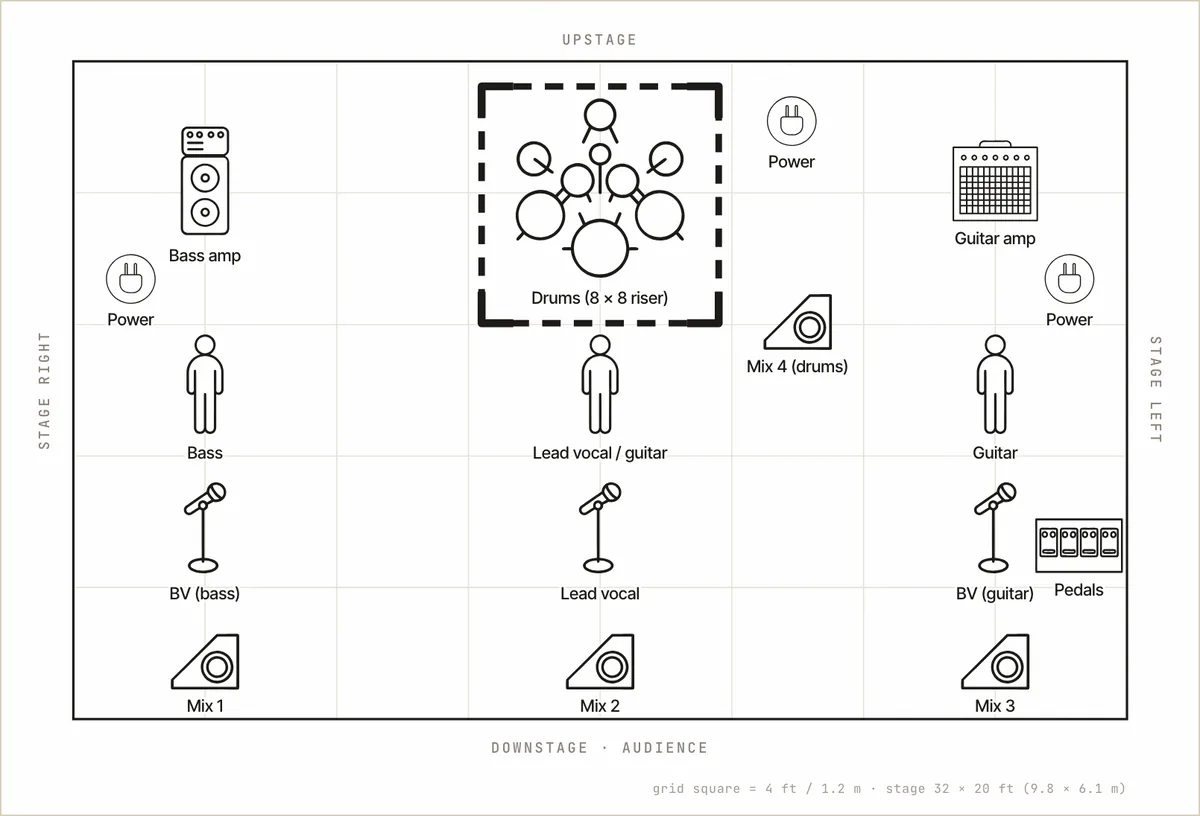
Each amp sits behind the player who uses it, bass stage right and guitar stage left, so everyone hears their own rig and the wedges only have to carry voices. The drums are on an 8 by 8 foot riser upstage center with their own wedge on Mix 4, and there are three power drops, one where each rig plugs in.
The riser is written as a preference, not a demand, because most small rooms do not have one. The input list runs to twelve channels in the order engineers patch: drums, bass, guitar, then the three vocals.
Input list, monitor mixes and the tech rider that goes with it
Input list: 12 channels
| Ch | Source | Mic / DI | Notes |
|---|---|---|---|
| 1 | Kick | Beta 52 or similar | short stand |
| 2 | Snare | SM57 | |
| 3 | Hi-hat | small condenser | |
| 4 | Rack tom | clip mic | |
| 5 | Floor tom | clip mic | |
| 6 | Overhead L | condenser | tall boom |
| 7 | Overhead R | condenser | tall boom |
| 8 | Bass | DI | post-amp if possible |
| 9 | Guitar amp | SM57 or similar | short stand |
| 10 | Lead vocal | SM58 or similar | boom stand |
| 11 | BV (bass) | SM58 or similar | boom stand |
| 12 | BV (guitar) | SM58 or similar | boom stand |
Monitor mixes
Mix 1 (stage right wedge, bass): bass vocal, kick, lead vocal Mix 2 (center wedge, lead): lead vocal, a little kick and snare, guitar Mix 3 (stage left wedge, guitar): guitar vocal, lead vocal, guitar amp Mix 4 (drum wedge): kick, bass, lead vocal
Backline, power, notes
We bring all backline. Need 3 vocal mics on boom stands, 4 wedges, and a drum riser if the room has one (not essential). Set is 45 min. 20 min sound check is plenty.
The tech rider
Lineup
1. Lead vocal, electric and acoustic guitar 2. Guitar, backing vocal 3. Bass, backing vocal 4. Drums
Schedule
Set length: 45 min (75 min if headlining) Sound check: 20 min; a line check is fine if we are not on first Load-in: 4 people, one van, 15 min to set up backline
We bring
All backline: drum kit with cymbals and hardware, bass head and cab, guitar amp, pedalboards, instrument cables, and stands for our own guitars.
We need from the venue
PA and engineer suited to the room. 3 vocal mics on boom stands (SM58 or similar). Drum mics: kick, snare, hi-hat, two toms, overhead pair. 1 active DI for bass (post-amp is fine). 1 SM57 for the guitar amp. 4 wedges on 4 mixes; 3 mixes minimum. Drum riser 8 x 8 ft if the room has one, not essential.
FOH and power
House engineer mixes; we do not travel one. Power: 3 drops, stage right (bass), stage left (guitar and pedals), upstage center (drums). Standard outlets, one duplex each.
Lighting
House wash is fine. No strobes during the acoustic song (song 6). We do not travel a lighting person.
Hospitality
Water on stage for 4. A green room or a corner for cases. 4 guest list spots where possible.
02 7-piece with keys and horns
7-piece band stage plot with keys and horns: more mixes, same page.
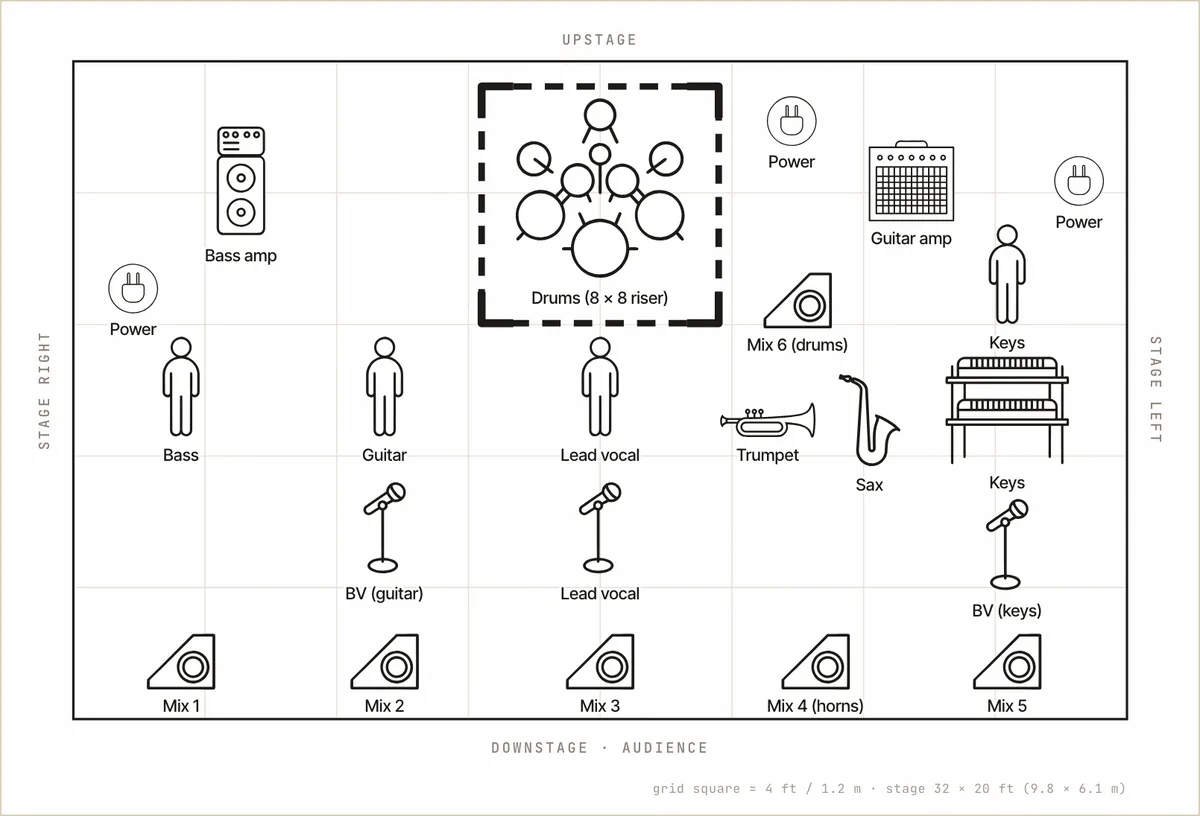
Seven people still fit on one page. The keys get their own corner stage left, with a backing vocal and Mix 5. The trumpet and sax stand together between the singer and the keys and share Mix 4. The notes set the floor: six mixes if the room has them, four minimum, with the horns and keys sharing.
The two-tier keys take four DI channels (two keyboards in stereo), which is why the input list runs to eighteen channels. With seven people on stage, the rider asks for a 30-minute sound check.
Input list, monitor mixes and the tech rider that goes with it
Input list: 18 channels
| Ch | Source | Mic / DI | Notes |
|---|---|---|---|
| 1 | Kick | Beta 52 or similar | short stand |
| 2 | Snare | SM57 | |
| 3 | Hi-hat | small condenser | |
| 4 | Rack tom | clip mic | |
| 5 | Floor tom | clip mic | |
| 6 | Overhead L | condenser | tall boom |
| 7 | Overhead R | condenser | tall boom |
| 8 | Bass | DI | post-amp if possible |
| 9 | Guitar amp | SM57 or similar | short stand |
| 10 | Keys 1 L | DI | |
| 11 | Keys 1 R | DI | |
| 12 | Keys 2 L | DI | |
| 13 | Keys 2 R | DI | |
| 14 | Trumpet | SM57 or clip mic | |
| 15 | Sax | SM57 or clip mic | |
| 16 | Lead vocal | SM58 or similar | boom stand |
| 17 | BV (guitar) | SM58 or similar | boom stand |
| 18 | BV (keys) | SM58 or similar | boom stand |
Monitor mixes
Mix 1 (bass): bass, kick, lead vocal Mix 2 (guitar): guitar vocal, lead vocal, keys Mix 3 (lead vocal): mostly lead vocal, a little kick and snare Mix 4 (horns, shared): horns, lead vocal, kick Mix 5 (keys): keys vocal, lead vocal, bass Mix 6 (drums): kick, bass, lead vocal, keys
Backline, power, notes
We bring all backline including keys stand. Need 3 vocal mics on booms, 2 short stands for horns (or clip mics), 6 wedges on 6 mixes if possible, 4 mixes minimum (horns and keys can share). Drum riser welcome. Set 60 min.
The tech rider
Lineup
1. Lead vocal 2. Guitar, backing vocal 3. Bass 4. Keys, backing vocal 5. Drums 6. Trumpet 7. Sax
Schedule
Set length: 60 min Sound check: 30 min; there are seven of us on stage Load-in: 7 people, two vehicles, 20 min to set up
We bring
All backline: drum kit, bass rig, guitar amp, keys with stand, horn stands, all instrument cables.
We need from the venue
PA and engineer. 3 vocal mics on booms. Drum mics as per the input list. 5 DIs (4 for the two keyboards in stereo, 1 for bass). 2 short stands with SM57 or clip mics for the horns. 6 wedges on 6 mixes if possible; 4 mixes minimum (horns and keys can share). Drum riser welcome.
FOH and power
House engineer mixes. Power: 3 drops, stage right (bass), stage left (guitar and keys), upstage center (drums).
Lighting
House wash. Something warm for the ballad. No strobes.
Hospitality
Water for 7 on stage. Green room or a safe place for cases. Parking for two vehicles at load-in.
03 Singer-songwriter duo
Singer-songwriter duo stage plot: two people, two wedges.
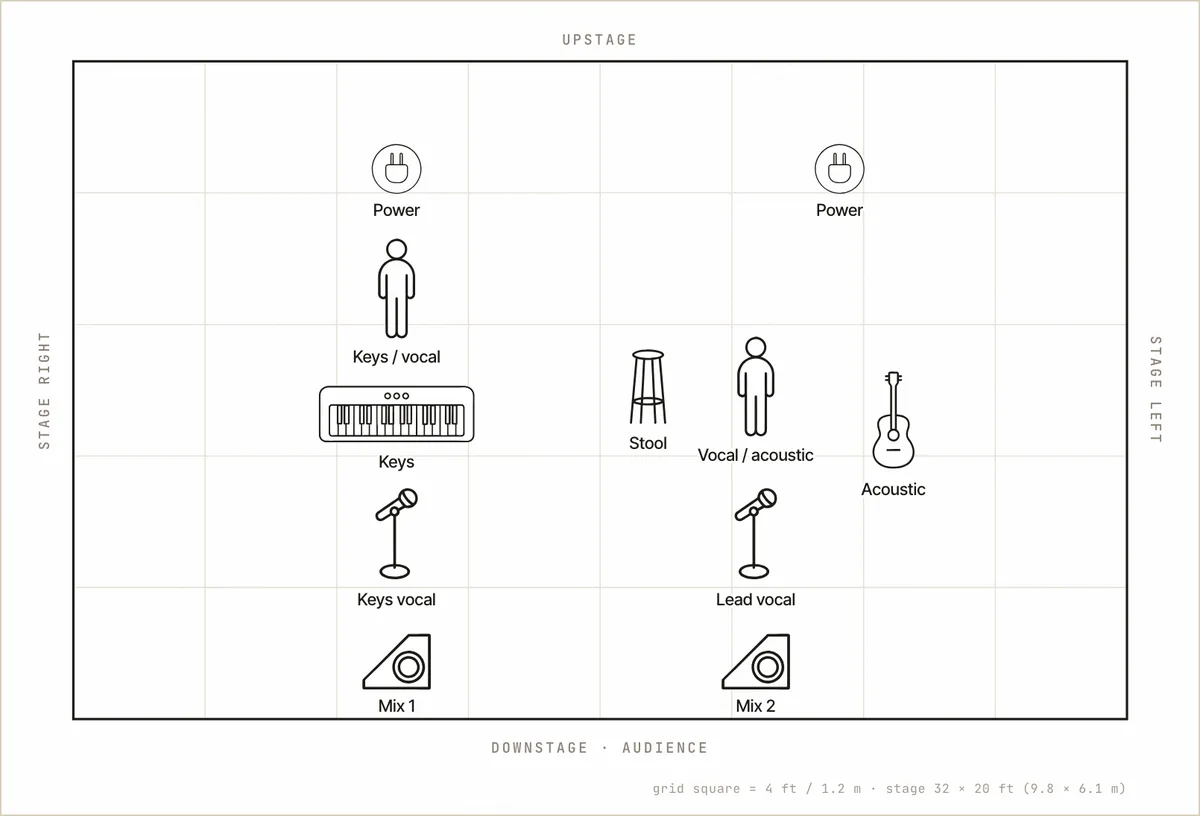
Two performers, two vocal mics, two wedges on two mixes, and a power drop behind each of them. The keys sit stage right with their own vocal; the singer-guitarist is stage left of center with a stool beside them, and the acoustic goes through an active DI.
The notes say what to do if the room is short of DIs (keys in mono is fine) and that a line check is enough. That is the kind of line that gets a duo on stage on time.
Input list, monitor mixes and the tech rider that goes with it
Input list: 5 channels
| Ch | Source | Mic / DI | Notes |
|---|---|---|---|
| 1 | Keys L | DI | |
| 2 | Keys R | DI | |
| 3 | Acoustic | DI | onboard pickup |
| 4 | Lead vocal | SM58 or similar | boom stand |
| 5 | Keys vocal | SM58 or similar | boom stand |
Monitor mixes
Mix 1 (keys): keys vocal, lead vocal, a little acoustic Mix 2 (lead): lead vocal, acoustic, keys
Backline, power, notes
Two of us. We bring the keyboard and stand. Need 2 vocal mics on booms, 1 active DI for the acoustic (2 DIs for keys if you have them, otherwise mono is fine), 2 wedges, 1 stool. Set 2 x 45 min. Line check only.
The tech rider
Lineup
1. Lead vocal, acoustic guitar 2. Keys, vocal
Schedule
Set length: 2 x 45 min Sound check: Line check, 10 min Load-in: 2 people, one car, 10 min to set up
We bring
Keyboard and stand, acoustic guitar with onboard pickup, cables.
We need from the venue
PA and engineer. 2 vocal mics on booms. 1 active DI for the acoustic, 2 DIs for keys (mono is fine). 2 wedges on 2 mixes. 1 stool.
FOH and power
House engineer. Power: 2 drops, keys (stage right) and the acoustic side (stage left).
Lighting
Whatever the room has. No preferences.
Hospitality
Two waters. Nothing else needed.
04 Solo acoustic
Solo acoustic stage plot: one mic, one DI, one outlet.
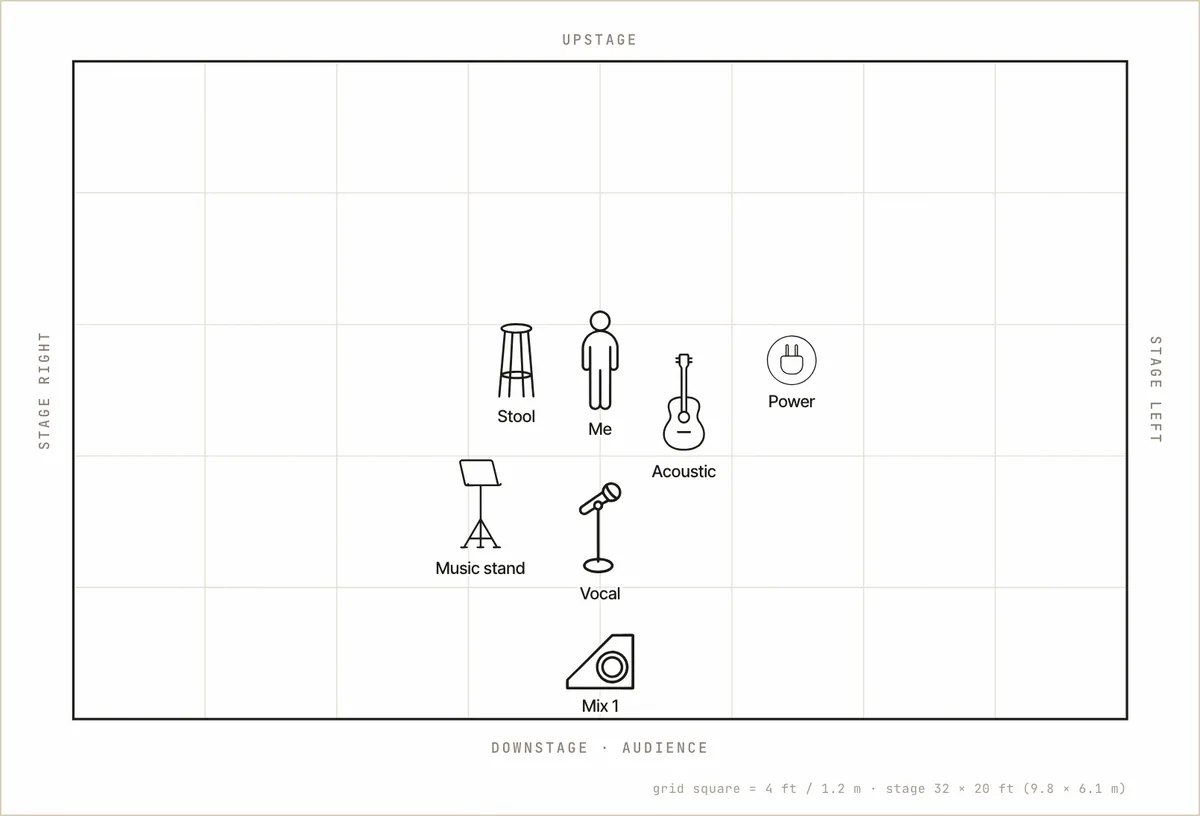
It looks like almost nothing, and that is the point: one vocal mic on a boom, one DI for the guitar, one wedge, a stool, a music stand, and one outlet. Sent ahead, it tells the engineer there is no amp to mic and nothing to wait for.
The notes say a ten-minute line check is plenty and that the guitar can go straight into the desk. Two input channels, and the engineer knows it before you arrive.
Input list, monitor mixes and the tech rider that goes with it
Input list: 2 channels
| Ch | Source | Mic / DI | Notes |
|---|---|---|---|
| 1 | Acoustic | DI | onboard pickup |
| 2 | Vocal | SM58 or similar | boom stand |
Monitor mixes
Mix 1: vocal, a little guitar
Backline, power, notes
Solo. One vocal mic on a boom, one active DI, one wedge, one power outlet, one stool. A ten minute line check is plenty. I can go direct into the desk with no amp.
The tech rider
Lineup
1. Vocal, acoustic guitar
Schedule
Set length: 45 min, can stretch to 2 x 45 Sound check: 10 min line check Load-in: 1 person, 5 min to set up
We bring
Acoustic guitar with pickup, cables, a small pedal (tuner and reverb).
We need from the venue
PA and engineer. 1 vocal mic on a boom. 1 active DI. 1 wedge. 1 stool. 1 power outlet.
FOH and power
House engineer. One power outlet near the stool.
Lighting
Whatever the room has.
Hospitality
Water. Parking for one car if there is any.
05 Jazz trio
Jazz trio stage plot: drawn for a quiet stage.
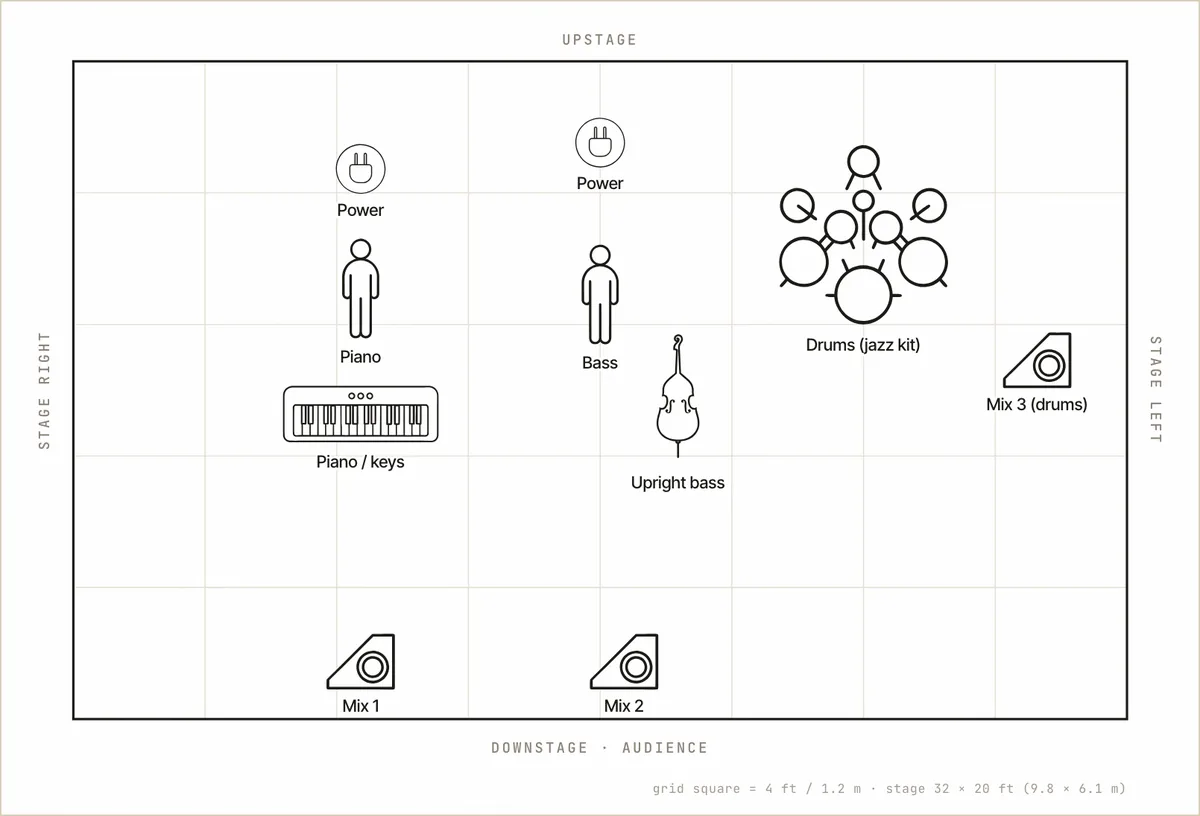
The piano is stage right, the upright bass in the middle where both other players can see it, and the jazz kit upstage stage left with its own wedge on Mix 3. Power goes to the piano and to the bass, and nothing is needed at the drums.
The notes carry the useful detail: if the room has a real piano the trio will play it, a clip mic on the bass is nicer than the DI, and the monitors stay low. The input list shows every channel the kit can take; the notes say kick, snare and an overhead pair are enough.
Input list, monitor mixes and the tech rider that goes with it
Input list: 10 channels
| Ch | Source | Mic / DI | Notes |
|---|---|---|---|
| 1 | Kick | Beta 52 or similar | short stand |
| 2 | Snare | SM57 | |
| 3 | Hi-hat | small condenser | |
| 4 | Rack tom | clip mic | |
| 5 | Floor tom | clip mic | |
| 6 | Overhead L | condenser | tall boom |
| 7 | Overhead R | condenser | tall boom |
| 8 | Upright bass | DI or clip mic | |
| 9 | Keys L | DI | |
| 10 | Keys R | DI |
Monitor mixes
Mix 1 (piano): bass, a little kick and snare Mix 2 (bass): piano, kick Mix 3 (drums): piano, bass
Backline, power, notes
Trio, acoustic-leaning. If the room has a real piano we will use it (one or two mics, or a pickup). Kick, snare, and an overhead pair is enough on the kit. Bass has a pickup; a DI is fine, a clip mic is nicer. Quiet stage, keep monitors low.
The tech rider
Lineup
1. Piano / keys 2. Upright bass 3. Drums
Schedule
Set length: 2 x 60 min Sound check: 15 min Load-in: 3 people, one van, 15 min to set up the kit and bass
We bring
Small jazz drum kit, upright bass with pickup, digital piano and stand if the room has no piano.
We need from the venue
PA sized for a quiet stage. If the room has a piano, tuned please, with one or two mics or a pickup. Kick, snare, and an overhead pair on the kit. 1 DI for the bass (a clip mic is nicer). 3 wedges on 3 mixes, kept low.
FOH and power
House engineer. Power: piano (stage right) and bass amp if used (center). Nothing needed at the drums.
Lighting
Warm and low. No moving lights please.
Hospitality
Water for 3. A small table for merch if possible.
06 DJ
DJ stage plot: the booth, from above.
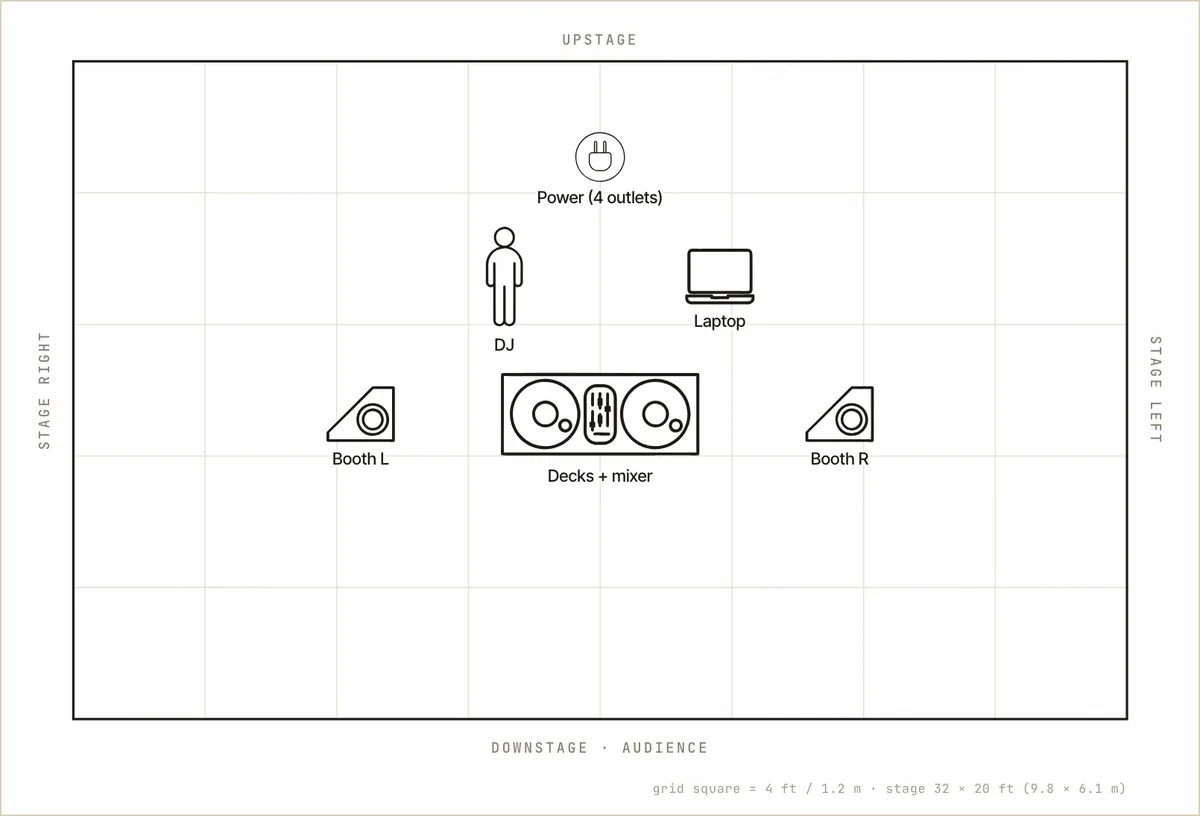
The simplest plot on this page, and the one venues most often never receive. The table sits at center with the decks and mixer on it, the DJ and the laptop behind it, a booth monitor on each side, and one power drop with four outlets.
The notes give the table height (about 40 inches) and the two outputs to the house, the two things a booth most often gets wrong. The whole DJ rider, with the choice between a controller, house CDJs and vinyl, is on the DJ tech rider template.
Input list, monitor mixes and the tech rider that goes with it
Input list: 2 channels
| Ch | Source | Mic / DI | Notes |
|---|---|---|---|
| 1 | DJ L | XLR or DI from mixer | |
| 2 | DJ R | XLR or DI from mixer |
Monitor mixes
Booth monitors L and R: full house mix, loud, no delay. One mix is fine.
Backline, power, notes
Bringing laptop and controller. Need a stable table about 40 in / 100 cm high, 2 x XLR (or 2 x DI) from my mixer to the house, 2 booth monitors, and 4 power outlets at the table.
The tech rider
Lineup
1. DJ
Schedule
Set length: 90 min, can extend Sound check: 10 min line check Load-in: 1 person, 5 min; the table needs to be in place when I arrive
We bring
Laptop, controller, all cables, headphones.
We need from the venue
A stable table about 40 in / 100 cm high. 2 x XLR (or 2 DIs) from my mixer to the house. 2 booth monitors. 4 power outlets at the table. If the club has CDJs and a DJM mixer I can use those instead: tell me the models.
FOH and power
House engineer or the room's system tech. Power: 4 outlets at the table on one drop.
Lighting
Club lighting is fine. No cues.
Hospitality
Water at the booth. Guest list for 2.
07 Reading them
How to read a stage plot: four conventions.
- The audience is at the bottom. The drawing is the stage seen from above, with downstage, the edge nearest the crowd, at the bottom of the page.
- Stage left and right are the band's. Stage right is the performer's right as they face the crowd, which is the left side of the page. Every example above labels both sides.
- One grid square is 4 feet. The examples are drawn on a 32 by 20 foot stage and the gear is at true size, so you can see what fits.
- Wedges are numbered by mix. “Mix 4 (horns)” is one monitor mix; two wedges can share a mix, and the monitor list says what each one carries.
What belongs on a plot and what does not, the input list order, and how many monitor mixes a small act should ask for are all in the guide on the stage plot maker page.
08 Your own
Stage plot template: make yours from the closest example.
- Open the example closest to your lineup in the free stage plot maker. Each one above has a link.
- Rename the performers and delete what you do not use. The input list follows as mics and DIs come and go.
- Drag the gear to where your band really stands. Stage left is your left.
- Pick the stage size closest to the room, from a 16 by 12 foot bar corner to a 40 by 28 foot big room.
- Add the venue, the date and a phone number, then download the PDF in Letter or A4, or copy a share link for the rest of the band.
No account at any step. The Tech rider tab turns the same plot into a two-page tech rider, and the hospitality rider template adds the page about food, rooms and parking.
09 Quick answers
Stage plot examples: common questions.
- What does a stage plot look like?
- A top-down drawing of the stage with the audience at the bottom: each performer, amp, mic, DI, monitor wedge and power drop in its place and labeled, with stage left and stage right marked from the band's side. A numbered input list and the monitor mixes go with it, usually on the same page. The six examples on this page are drawn that way.
- How do I make a stage plot from one of these examples?
- Open the example in the free stage plot maker (each one has a link), rename the performers, drag the gear to where your band stands, and delete what you do not use. The input list updates as mics and DIs come and go. Then download the PDF in Letter or A4. No account is needed at any step.
- What is the difference between a stage plot and an input list?
- The stage plot is the drawing. The input list is the table of every channel the engineer patches, in order: drums, bass, guitars, keys, other instruments, vocals. They travel together, and every mic and DI on the list should be on the drawing.
- Do I need a stage plot for an acoustic duo or a solo show?
- Yes, and it takes a couple of minutes. Even one person with a guitar tells the engineer something useful: one vocal mic, one DI, one wedge, a stool, and where the outlet goes. The solo and duo examples on this page are ready to copy.
- Is a stage plot drawn from the audience's view?
- The page is laid out with the audience at the bottom, as if you were looking at the stage from the house. Stage left and stage right are still the performer's left and right as they face the crowd, so stage right is on the left side of the page. Label both sides so nobody has to guess.
- What size stage are these examples drawn for?
- 32 by 20 feet, a standard club stage, at true scale: one grid square is 4 feet. In the stage plot maker you can switch to a 16 by 12 foot bar corner, a 24 by 16 club, a 40 by 28 big room, or your own size, and the gear keeps its real size so you can see what fits.
- Are these real bands' stage plots?
- No. They are the six presets in the LiveEPK stage plot maker, written the way those kinds of acts really advance a show so they are ready to edit. Add your own band name, venue and date before you send one.
Start from the closest example.
The stage plot maker opens on the 4-piece rock band. Pick another from its Start from menu, or open one from this page, and download a one-page PDF. Free, no account, nothing to install.
Open the stage plot makerWant it with your press kit? The free EPK builder publishes the PDF in your kit's Downloads, next to your photos and bio.